Singapore and Ireland’s Tax Regimes Attract World-Beating Levels of FDI

Europe’s open economies outperform the BRICs

Belgium third in absolute terms

Singapore, Ireland and Belgium’s favourable tax systems have helped them to outperform the rest of the world in attracting Foreign Direct Investment in the five years since the global credit crunch, according to a new study by UHY, the international accountancy network.

Over the period Belgium attracted Foreign Direct Investment equivalent to 91% of its GDP (a total of US$442 billion), while Singapore attracted the equivalent of 74% of its GDP ($203 billion in total) and Ireland 44% (a total of $93 billion). 

On average, countries have attracted FDI worth 17% of their GDP in the five years since the credit crunch.

The study looked at net FDI inflow over the last five years in 33 major economies around the world, measuring how successful they have been in attracting FDI compared to their GDP. 

Winning Foreign Direct Investment provides an important boost to national economies, creating new jobs and tax revenues in the short term, and in the longer term improving productivity by helping to fund capital investment and making domestic companies more competitive.

UHY explain that Ireland and Singapore have been enormously successful in setting up favourable tax and regulatory environments that have encouraged companies to set up regional headquarters there.  For example, Yahoo, Google, Apple, PayPal and LinkedIn all have European headquarters in Ireland, and Asian headquarters in Singapore. 

Both Ireland and Singapore offer low corporation tax rates compared to other countries in their regions, as well as attractive transfer pricing arrangements for international groups. Singapore also offers a number of tax incentives for companies active in target sectors including shipping, commodities trading, fund management and biotechnology.

However, top place in the table was taken by Belgium, which has attracted net FDI equivalent to 91.4% of its GDP over the last five years – FDI totalling over US $442 billion.  In terms of the absolute amount of FDI received it was behind only the USA (which received over $1 trillion) and China ($563 billion). 

Belgium has been particularly innovative in its use of tax legislation to attract international companies. While it has recently phased out the role of so-called ‘co-ordination centres’ for inter-company loans which helped companies to manage their global tax liabilities, it now hopes to differentiate itself by providing tax reliefs for companies that fund their businesses through equity rather than debt.  In addition, Belgium has generous tax breaks for R&D and investment in capital goods, as well as fiscal incentives for hiring employees.  Belgium’s attractiveness as a European HQ is reinforced by the access it offers to EU decision makers and its importance as a logistics location.

The two bottom performing countries in the study were Italy and Japan: Italy attracted the equivalent of 3.1% of its GDP over the five year period, and Japan just 0.6%.  Both can be difficult environments for foreign investors to acquire assets in.  Germany also did less well than might be expected, ranking in the bottom five in terms of the value of FDI it attracted as a percentage of its GDP.  UHY explain that the processes for establishing a company in Germany are complex, which can deter certain types of foreign investment.

Over the last five years, the USA and China pulled in the largest amount of FDI in absolute terms, though FDI represent a smaller share of their overall economies.

Ladislav Hornan, Chairman UHY, comments: “Small economies such as Singapore and Ireland can punch well above their weight by offering significant tax incentives to companies choosing to locate there.”

“But those tax incentives only work because they also have a well-educated workforce, strong infrastructure and the sophisticated ecosystem of suppliers that a multinational needs when they decide to locate to a country.”

“Although labour, real estate and energy costs tend to be far lower in emerging markets than in developed economies these figures show that developed economies that offer the right incentives, are able to attract in even higher levels of FDI.”

EU countries’ generally open economies allowed them to attract strong FDI inflows relative to their size, pulling in, on average FDI equivalent to 20% of their GDP over the period compared to an average of 10% for the BRIC economies.  UHY say that despite the scale of the investment opportunities in these growing economies, complex tax systems, unpredictable bureaucracies and limits on foreign ownership in certain sectors are proving a barrier.

Eric Waidergorn, Director of UHY Moreira Auditores, member of UHY in Brazil said: “Brazil is an exciting prospect for investors – it is a huge and growing economy with enormous mineral wealth and a young population that is becoming increasingly wealthy.  Unfortunately, the practicalities of investing in Brazil can be off-putting.  Our tax system is not well understood by overseas investors, certain sectors such as health-care are completely off-limits and there are restrictions on foreign ownership in others.”

“However, the national and regional governments are aware of the need to attract more FDI, and some overseas investors can enjoy exemption from certain federal and regional taxes.  What is needed is simplification so that Brazil can put what is ultimately a compelling investment case much more clearly.”

UHY says that many other countries have put off foreign investment by actively discouraging the takeover of domestic companies by foreign investors.  Egypt, Mexico and Spain are amongst the countries which have caps or outright bans on foreign ownership of companies or assets that are regarded as strategic, which may include nuclear power, oil, air transport, the media and defence industries or even agricultural land.  In the USA, certain transactions may be scrutinised by the Committee on Foreign Investment in the United States to determine whether they are potentially detrimental to US national security.

Says Ladislav Hornan: “Although there are occasional setbacks to the process, the long term trend has been for more economies to open up to all kinds of FDI.”

“The benefits certainly outweigh the downside, and that is why governments in many developed economies place a great emphasis on ensuring that they remain attractive to overseas investors.  In addition to tax incentives, that can include developing recognised expertise in high value and high technology industries, as Israel has done, or putting transport and other infrastructure in place that will encourage investment in neglected areas or assets.”

Alan Farrelly at UHY Farrelly Dawe White Limited, member of UHY in Ireland, commented: “The Irish tax system has been very successful in attracting Foreign Direct Investment.  While maintaining low corporate tax rates has not been uncontroversial at a time when we have gone through a painful austerity programme, it has helped Ireland to create and retain a lot of highly skilled jobs.”

Franck Narquin, partner at UHY GVA, member of UHY in France, which came in 25th place out of the 33 countries, added:  “The French Government  is aware of the need to attract more FDI, and has drawn up a ‘National Pact for Growth’, to help achieve this.  France already has great strengths in areas like science and offers generous research tax credits, but there needs to be more focus on cutting red tape and reducing labour costs.” 

USA and Japan far behind Europe and China in race to harness globalisation

Would-be Chinese and American multinationals held back by tax policy.

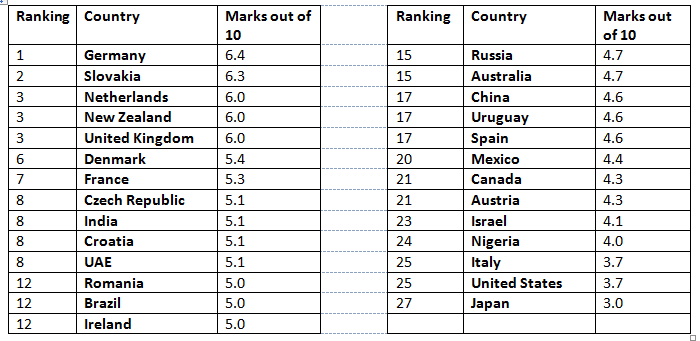
UHY taxation and business advisory professionals in 27 countries rated their economies on several factors including taxation and trade policy, that indicate how internationalised an economy already is and how well positioned it is to take advantage of future globalisation of trade.  

The USA and Japan are falling behind Europe and China in the race to capitalise on globalisation and could miss out on future economic growth as a result, according to a new study by UHY, the international accounting and consultancy network.

UHY taxation and business advisory professionals in 27 countries rated their economies on several factors including taxation and trade policy, that indicate how internationalised an economy already is and how well positioned it is to take advantage of future globalisation of trade.  

The factors examined in UHY’s study included; how successful a country has been in negotiating favourable tax arrangements with potential trading partners, how successful it has been in growing exports, how important a part trade already plays in its economy, how much tax it imposes on companies ‘repatriating’ overseas profits, how it is rated in the World Bank’s ‘Ease of Doing Business’ survey, and labour costs.  

Assessed on these factors, the USA and Japan with scores of 3.7 and 3.0 respectively were surprisingly far behind both China, with its score of 4.6, and the EU member states, with an average score of 5.2 out of a maximum of 10. 

While the USA and Japan both did well on their ‘Ease of Doing Business’ rating, their economies still remain more aligned to domestic activity than many of their competitors.  UHY explains that this means companies in these countries are not fully exposed to international competition, which may make them less effective internationally.  Additionally, both countries also had low scores for the factors measuring their success in negotiating favourable tax treatment by trading partners.

Germany topped the ratings with a score of 6.4 out of ten, while Slovakia was not far behind on 6.3 points.  China was the best performing of the world’s top 3 economies with a score of 4.6, and India was the best-performing BRIC with a score of 5.1, helped by its low labour costs with an average monthly salary less than half as high as China’s. 

Ladislav Hornan, chairman of UHY commented: “While both Japan and the USA still have huge domestic economies to help generate growth, making a more concerted effort to open themselves up to global trade and global competition could pay dividends in the future.  Japan in particular is very conscious of the need to revive its economy after the lost decade has drifted into two decades.”

“Japan was once seen as having an unassailable lead in consumer electronics and a level of high-tech expertise that outweighed relatively high labour costs.  No longer: Korean and Taiwanese giants like Samsung, LG and Foxconn now dominate that industry.”

Rick David of UHY LLP, member of UHY in the USA, stated: “In the past Canada, Mexico, Japan and the EU have been some of our most important and most co-operative trading partners, but it is perhaps time for policy makers to look at how we can improve relationships with emerging economies in Africa and Southern and South East Asia that are going to become bigger consumers and bigger importers as their incomes grow.”

Akira Wakatsuki of UHY Tokyo & Co and member of UHY in Japan, comments “So far, one of the centre pieces of recent Japanese economic policy – the devaluation of the Yen – has only had a limited impact on exports.   It may be that domestic structural reforms and Japan’s intention to open up more to free trade through its participation in talks on the Trans-Pacific Partnership (TPP) are ultimately more successful in helping the economy to compete more successfully with cheaper, rival Asian economies.”

Within Europe, UHY point out that Slovakia, the Czech Republic and Romania have been very effective in taking advantage of the opportunities presented by the single market.  Meanwhile, Spain, pulled out of recession in the third quarter of 2013 thanks to export growth, and could potentially see its trade position improve in the future.   Georg Stöger of AUDITOR, UHY member firm in the Czech Republic and Slovakia said: “Slovakia in particular has been very effective in making the most of its EU membership and still relatively low labour costs.  Its government has pursued a liberalisation agenda, and thanks to its traditional strengths in manufacturing, it’s becoming an increasingly important location for international businesses.” 

“Currently countries like the Czech Republic, Romania and Slovakia all benefit from fairly low labour costs.  As they continue to build up their skills base, improve infrastructure and reduce local bureaucracy they could become formidable competitors, especially if they are able to make the transition from trading within the EU to trading globally.”

Would-be Chinese and American multinationals held back by tax policy

While China did far better overall than the USA, with an overall score of 4.6 out of 10, both of the world’s two largest economies’ scores – were also brought down by the high taxes their governments impose on corporates ‘repatriating’ overseas profits. 

UHY says that these taxes reduce the incentive for businesses to set up subsidiaries overseas, particularly for SMEs for whom the costs of setting up international operations would be proportionately more expensive.  Just under half of the countries in the study imposed no tax on repatriated dividends at all.

Rick David added: “American firms are household names around the world but actually our taxation system is very poorly geared towards encouraging US companies from growing overseas, with the highest tax on ‘repatriated’ profits of any country in the study.”

Rankings showing 27 countries’ ability to take advantage of future globalisation of trade

Notes:

Countries’ overall scores are based on their rankings for the detailed measures included in the study.

Data drawn from: the World Bank, World Trade Organisation, International Labour Organisation and national governments.

General Satellite Group

General Satellite Group provides TV broadcasting, electronic production and media services in Europe,China and Russia. UHY member firms in Russia and Pakistan worked with the group’s HQ in Russia and the GS Group in Pakistan where it is launching a new digital broadcasting service.

Read more.

LA ZAGALETA S.L.U

LA ZAGALETA S.L.U is the creator, owner and development company of ‘Club de Campo LA ZAGALETA®’, considered Europe’s most exclusive gated residential and golfing estate.  UHY member firms in Spain and the UK  work closely to audit the accounts of LA ZAGALETA GROUP® internationally. UHY Fay & Co also performs tax consultancy work for the group on a national and international level.

Read more.

International Healthcare Services Ltd (IHS)

International Healthcare Services Ltd (IHS) provides specialised services in healthcare in the Caribbean and Africa, leveraging technology advances to pioneer innovative solutions. UHY member firms have provided financial services for IHS and its subsidiary companies in Jamaica and recently in Nigeria where it plans to launch DOCS services and a telemedicine service.

Read more.

TOYA S.A.

TOYA S.A. is a market leader in the Polish hand and power tools for both professional and household use. The TOYA group has subsidiaries in Romania and china and an extensive sales network in Europe, Asia, Africa, Australia, and Central and South America. Our member firm, UHY Audit CD S.r.l., Romania, provided audit services to TOYA Romania S.A.

Read more.

Global LT

Global LT  provides global language and cultural training, translation, expatriate destination services and workforce talent development solutions. UHY member firms in the US, UK, Brazil and Hong Kong work together to provide services including accounting, tax, professional business advisory and legal services.

Read more.

Alloy Steel International

Alloy Steel International, Inc. (AYSI), trading on the OTC, manufactures Arcoplate, a wear-resistant fused-alloy steel plate. UHY Haines Norton (Perth) has been providing audit services to all entities in the group supported by, UHY LLP, US, to provide peer reviews of US GAAS and US GAAP.

Read more.

blowUP media

blowUP media is known for its Giant Poster advertising in major cities across Europe. The company is part of The Ströer Group, based in Germany, one of the biggest international marketers of out-of-home-media and street furniture.

Read more.