


Author Archives: Andrea Fantechi
Doing Business in Czech Republic
Doing Business in Cyprus
Doing Business in Croatia
Doing Business in Albania
European economies levy some of the world’s highest property purchase taxes on prime real estate – UHY’s global study reveals
European economies levy some of the highest property purchase taxes in the world on prime real estate, charging on average 4%, or USD 38,356, in tax on a property purchase of USD 1 million, reveals a new study by UHY, a leading international accounting and consultancy network.
UHY says that major European economies including France, Germany, and Spain levy among the highest property purchase taxes in the world (see table below).
UHY says that although high property taxes are an attractive source of revenue for governments, they could risk discouraging labour market mobility and valuable overseas investment from High Net Worth individuals.
UHY’s findings show that Belgium has the highest average property taxes for real estate worth USD 1 million of any country in the study at 11.3%* – a charge of USD 113,131.
Other western European economies at the top of the table include France and Germany, charging USD 50,901 and USD 50,000 respectively on residential property transactions worth USD 1 million.
This is far higher than the global average of 3.3% (USD 33,038) for properties in this price bracket.
By contrast, many other advanced economies have far lower property purchase tax rates on prime real estate. For instance although the rate can vary across states, the US levies just 0.6% on average (USD 5,970) and Canada charges an average of 1.8% (USD 17,833).
Ireland also charges significantly lower taxes than its Western European neighbours at just 1% (USD 10,000).
UHY tax professionals studied tax data for individuals purchasing a house worth USD1 million in 26 countries across its international network, including all members of the G7, as well as key emerging economies.
UHY says that while the G7 economies charge on average 3%, (USD 29,720) – broadly in line with the global average – tax charges in the BRIC economies are around a third lower at 2.3% (USD 22,720).
New Zealand and Russia have the lowest taxes in the table, effectively charging 0% on prime property purchases.
New Zealand has no central or local government transaction taxes on real estate and residential property deals between home owners, as they are exempt from the government’s Goods and Services tax. Similarly Russia imposes no transfer taxes on the buyer, who only pays a minor fixed amount of State Duty of around USD 30.
Comments Bernard Fay, Chairman of UHY: “European economies continue to see property purchase taxes as a rich seam and a good way to bolster public finances which remain under intense strain. However, governments should be careful not to over-exploit it.”
“Higher property purchase taxes can also put a strain on domestic buyers, who may not actually be particularly wealthy, given house price inflation in some locations over the last decade or two.”
UHY points out that in the Netherlands the government reduced the Real Estate Transfer Tax in 2011 from 6% to its current 2% to help stimulate the housing sector for buyers. The lower rate is only applicable to residential property, with the higher 6% remaining for non-residential property.
Bernard Fay continues: “Levying significant taxes on the cost of a new property could constrain labour market mobility. If businesses have to offer much greater incentives for employees to relocate, this could have a serious impact on job creation and business investment in that country, and ultimately on its wider economy.”
UHY adds that in many countries, including Italy, Spain, and Uruguay, property purchase taxes are calculated using the value of the property in government registries, but these prices can often differ from the market value.
Comments Andrea D’Amico of UHY Advisor Srl in Italy: “Prime properties, especially in capitals, such as Paris or Berlin, are particularly desirable for wealthy investors from overseas, but excessively high taxes could make these markets less attractive. There’s a risk that they could lose out to locations such as New York where purchase taxes are seen as more reasonable.”
“These wealthy overseas investors contribute to the local economy in many other ways, through discretionary spending while they are staying in the property, as well as maintenance costs, for instance by refurbishing extensively, or employing staff.”
RESIDENTIAL PROPERTY TRANSFER TAXES FOR THE PURCHASER OF A PROPERTY WORTH USD$1,000,000
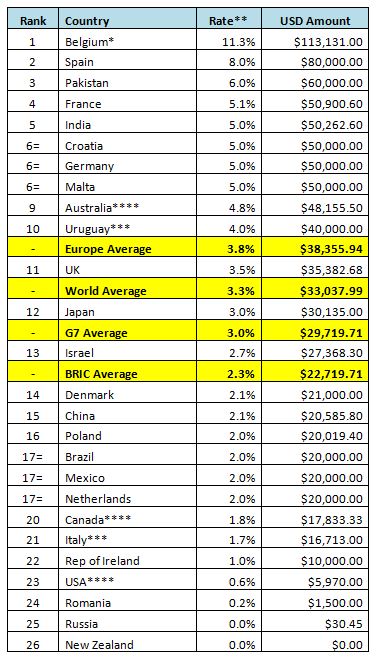
* This figure represents an average of the rates in Brussels, Flanders, and Wallonia which can vary from 9.8% to as high as 12.5%.
**Rates rounded to nearest tenth
***Rate paid on cadastral value of property, not market price; for Italy (based on 2015 data), it includes the law with the provision that the rate applies on the cadastral value of the property, which is largely lower than the market price
****Average of local variations
Doing Business in Honduras
Doing Business in Ecuador
Where start-ups succeed
Every thriving start-up ecosystem is unique, but they all find new and better ways of bringing the right people together.
If dark clouds have been gathering ominously over the global economy of late, one chink of sunlight continues to break through the gloom. According to a recent research study by UHY, many countries are experiencing a boom in new business creation.
That’s even true of China, where economic slowdown has spread panic through boardrooms from Beijing to Berlin. In fact, it’s especially true of China, UHY’s research confirms. The world’s most populous country is outpacing the world in new business formations. Nearly 1,610,000 new companies were established in China in 2014, almost double the number created in 2010. [Data correct to end of 2014].
Second in the league table of start-up success was the UK, which registered a 51% increase in business births in 2014 compared to 2010, while other winners included India, Australia, Italy and Germany. Brazil created 22% more businesses in 2014 than 2010, but started from the highest base of any nation in the UHY survey. Over one and a half million new companies were established in Brazil in 2010.
Some of this activity is the direct result of central intervention, with governments acting to kickstart economies left reeling by the financial crisis. Lower tax rates and reduced SME bureaucracy are the most obvious manifestations of government efforts. According to UHY International chairman Bernard Fay, these efforts must continue.
“The next few years are not going to be without their own challenges, and governments globally need to find ways to help these new start-ups grow into successful businesses and even the next generation of multinationals,” he says. “In many European countries there is still a long way to go in cutting down on bureaucracy.”
Reducing business bureaucracy is one way to encourage new start-ups, but there are others. Every start-up ecosystem is shaped by its peculiar local circumstances, and experts believe the best initiatives for encouraging business creation are homegrown and pragmatic. Nevertheless, successful start-up hubs, from Paris and London to Tel Aviv and Toronto, tend to share similar core components.
Peace and prosperity
At the most basic level, start-ups need peace, political stability and a culture that promotes entrepreneurship as a worthy life choice. All three are present in Indonesia, where entrepreneurs – as the Global Entrepreneurship Monitor (GEM) reports – exhibit ‘a low fear of failure’ which results in high levels of ‘early-stage entrepreneurial activity’.
If companies are to grow, entrepreneurs need access to finance and in some economies new funding avenues are rejuvenating start-up ecosystems. Peer-to-peer lending, crowdfunding and angel investing are filling the gap left by more risk averse institutions like banks and venture capital firms. The Association for Financial Markets in Europe calculates that 30% of finance available to European companies is now non-bank funding.
Meanwhile, GEM reports that physical infrastructure is considered the most valued component of a start-up hub by the start-up companies themselves. Good transport links and high speed internet is often essential to new business in a globalised world, wherever a start-up happens to blink into life. At the same time, many new businesses need access to an educated workforce and a set of core professional services.
But while the presence of these factors is clearly advantageous, experts warn that different start-up ecosystems have different priorities, and that no ‘one size fits all’ global model exists. Slavica Singer, professor of economics at the J.J. Strossmayer University of Osijek in Croatia and co-author of the GEM Global Report, argues that what ecosystems need most of all, regardless of the speed of local broadband services, is the flexibility to change and the wisdom to do so sensibly.
“Healthy start-up environments share the ability to change quickly, but without rushing into trendy solutions without sufficient thought,” she says.