Travellers around the world face complex web of taxes and charges

Average levy on ‘outbound’ economy flight now US$2

Taxes on flying inhibit economic growth and competition

Airlines and air passengers around the world face an increasingly complex web of taxes and airport charges that increase the cost of flying and inhibit economic competitiveness, according to a new study by UHY, the international accounting and consultancy network.   Around the world, the average levy that is now imposed on short haul flights by the country of departure is now US$23, and US$53 for a long haul flight, which can be more than 10% of the total cost of flying.

UHY explains that these additional costs damage tourism, penalise SMEs trying to expand overseas, disadvantage remote regional cities, and chip away at labour mobility.  Although taxes on flying are often billed as ‘green taxes’ UHY points out that it is exceptionally rare for the revenue they raise to be ring-fenced for environmental protection projects.

UHY looked at taxes and compulsory government charges imposed per passenger on an economy class flight by 21 governments around the world.  It also analysed additional charges imposed on a per passenger basis by airport operators.

UHY says that the most expensive taxes are for long haul flights departing from a Russian airport, where unlike many other countries, airline tickets are subject to sales taxes.  The highest taxes of any G7 economy are in the USA, which imposes US$23 worth of taxes on a short haul flight.

Within the EU, the UK still has the highest flight taxes: an adult with an economy short haul ticket flying from a UK airport will pay US$20 in tax.   For a first or business class ticket, the amount of tax paid would be even higher at US$41.    

Many smaller European countries do not impose any taxes on individual passengers, including Ireland, Slovakia, and Belgium.  In many cases there has been intense lobbying by local airports and business groups to keep taxes on flying to a minimum to prevent travellers using airports in neighbouring countries with lower taxes.    

Comments Ladislav Hornan, Chairman of UHY: “Airlines provide a crucial piece of infrastructure.  They facilitate a great deal of economic activity that is essential for countries that want to benefit from globalisation.  The higher the taxes on flying, the more they hurt airlines, business users and consumers.  That is why Russia is planning a temporary reduction to taxes raised on domestic flights in order to ease pressure on an aviation industry that is currently suffering severely.”

“Countries and cities that are expensive to fly to lose out on tourism.  High air taxes can also be harmful to businesses, as in many commercial relationships there is simply no substitute for face to face contact.”

“For smaller businesses, the cost of flying to see customers may be a serious consideration in deciding whether not to expand into new markets, especially overseas – it can lock them out of globalisation.  Taxes can add another 10 or 15% to the cost of flying, so they can pose a meaningful additional burden on budgets.”

UHY notes that lower taxes on flying in some countries, including China and France, seek to strike a balance between requiring aviation to make a contribution to government spending that it may benefit from and imposing high levies on passengers.

UHY adds that in the BRIC economies, flight taxes are actually higher than the global average, at an average US$21 for a short haul flight.  Long distances between cities and relatively weak road infrastructure in these countries make the alternatives to flying significantly less attractive, especially for business trips, so flights are a tempting target for taxes. 

Airport and airline charges lack transparency

UHY adds that on top of taxes and compulsory payments imposed by government bodies, additional airport fees levied on individual passengers for a short haul flight amount to a typical US$23 around the world.

Although airport fees are usually passed on to the consumer, airlines often complain that the charges amount to an abuse of an airport’s monopoly status if it has a particularly favoured geographic location near a major city. 

Airlines also add their own charges such as ‘fuel charges’ which many consumer groups argue should simply be included in the cost of the flight.

Adds Ladislav Hornan: “For consumers, taxes and fees are confusing; they mean the final ticket price is usually a shock.  They also add to the headache of working out how much extra a flight booked using air miles will actually cost, as well as what can be reclaimed if a customer has to cancel their ticket.”

“An EU study five years ago recommended that all air fares should state simply the basic air fare, airport charges and government taxes which are levied per passenger, and the total price.  The study said that the costs of operating the flight, such as ticketing or fuel, need to be included in the basic air fare.”

“Around the world, the issue of complex charges is an area where far greater progress needs to be made to ensure better transparency and competition.  Businesses and consumers would greatly benefit if regulators and tax authorities kept aviation taxes low and ensured that charges were more transparent.”

Table

*Russia levies sales taxes on airline tickets – calculations based on actual ticket price, Moscow to Novosibirsk / Moscow to New York

**based on international flight taken by a non-national – Egyptian nationals pay lower rate on departing international flight.

***Short haul calculation based on $165 total costs – flight Detroit to Miami.

Western European economies saddled with tax burden 40% higher than the global average

Low tax centres Dubai and Singapore hoping to lure high value industries from ‘Old Europe’

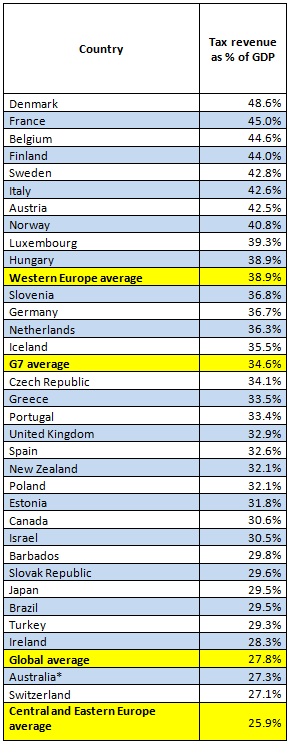
Western European countries are inhibiting their economies with tax burdens at least 40% heavier than both the global average and the average for neighbouring countries in Central and Eastern Europe, according to research by UHY, the international accounting and consultancy network.

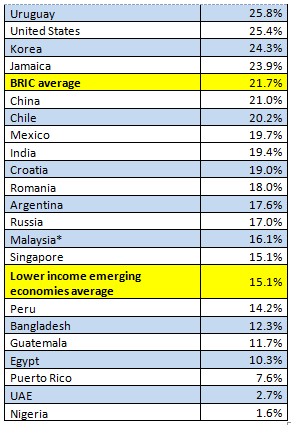
In the ‘Old European’ economies of Western Europe the total amount of tax taken by governments is an average of 38.9% of GDP, 40% higher than the 27.8% global average and higher still than the 25.9% average tax burden across Eastern Europe and the Balkans. 

In the BRIC economies the proportion of the economy claimed by the Government in tax is even lower, at an average of 21.7%, while the US Government’s ‘take’ from the economy is below the global average at 25.4% 

UHY examined 53 economies around the world, calculating what percentage of that country’s GDP is taken by the Government in tax.

Oil-rich Nigeria has one of lowest tax burdens of any major economy at 1.6% of GDP, even lower than in the UAE, where government levies on foreign oil producers, banks and some hotel and leisure businesses account for 2.7% of the Emirates’ combined GDP. 

The highest tax burden in the study was in Denmark, where the total amount of tax revenue taken equates to nearly half of the country’s GDP at 48.6%.

UHY says that Western Europe’s higher taxes on businesses, individuals, investors and consumer spending could all inhibit growth.  Higher taxes reduce incentives for investment and wealth creation, and prompt larger businesses to maximise returns for their investors by seeking out lower tax bases for their operations. 

In particular, Western Europe’s economies could be vulnerable to international rivals that are increasingly able to offer a combination of stable legal systems and highly skilled workforces. 

For example, the UAE and Singapore with tax burdens of 2.7% and 15% respectively are enjoying significant success in attracting corporate headquarters and professional and financial services companies, all creators of high skill, highly paid jobs. 

The Dubai International Financial Services has grown in the last 10 years to 1,100 companies, 70% of which originate from outside the Middle East, while Singapore is now home to over 200 banks and has growing expertise in other high value sectors including pharmaceuticals and medical technology.

Eastern European and Balkan countries are focussing on developing their industrial and manufacturing industries, offering lower taxes and lower costs than traditional Western European centres.  For example, Romania enjoyed 2.9% GDP growth last year, largely driven by expansion in its industrial and communications sectors.  It is becoming a growing centre for the auto manufacturing industry, with Daimler, Ford and Draexlmaier all choosing Romania over Germany for new plants in recent years.

Comments Ladislav Hornan, Chairman of UHY: “Unless they address their tax burdens, many Western European countries could find themselves pinched between lower cost, lower tax Eastern European countries that are able to offer equally strong manufacturing skills bases, and global cities like Singapore, Dubai and Qatar, that are consciously targeting the industries that create the most wealth.”

UHY point out that within Western Europe, Ireland, has the lowest tax burden at 28.3% of GDP.  Its lower taxes are a key part of its strategy of attracting high value industries such as financial services and technology companies. Dublin’s International Financial Services Centre is estimated to contribute over 7% of GDP with 35,000 employees, while Ireland is a major European base for 9 of the top 10 global software companies.

Comments Alan Farrelly of UHY Farrelly Dawe White Limited in Ireland: “While still relatively high by global standards, Ireland’s tax burden is significantly lower than in most of Western Europe.  This is strategy that appears to be paying off: the Irish economy grew by 4.8% in 2014, the fastest rate in the EU, and Ireland is attracting significant levels of foreign investment – it is the number one destination for US foreign direct investment.”

UHY adds that the BRIC economies impose bigger tax burdens than other, smaller emerging economies, which could see emerging markets investors looking beyond the BRICS for growth.  Tax amounts to an average of 21.7% of the BRIC economies, compared to 15.1% across the lower income emerging economies** in the study.

Adds Ladislav Hornan: “Analysts have been keen to coin all sorts of rival acronyms to the BRICs, and one reason may be that the tax burden in the BRICs, especially Brazil, is relatively high.” 

“For China, as economic growth starts to slow and the country gradually loses its cost advantage, especially compared with other Asian countries, the conundrum of whether and how to lower the tax burden will start to loom larger.”

**Nigeria, UAE, Puerto Rico, Egypt, Guatemala, Bangladesh, Peru, Singapore, Malaysia, Argentina, Romania, Croatia, Uruguay, Jamaica, Barbados

Capture1

Capture2

*Lower income emerging economies include: Nigeria, UAE, Puerto Rico, Egypt, Guatemala, Bangladesh, Peru, Singapore, Malaysia, Argentina, Romania, Croatia, Uruguay, Jamaica, Barbados

G7 economies risk undermining entrepreneurship with excess taxes on the sale of businesses

German business owners may pay almost half gains in tax and in France a third

By contrast BRICs economies pay just 16.7%

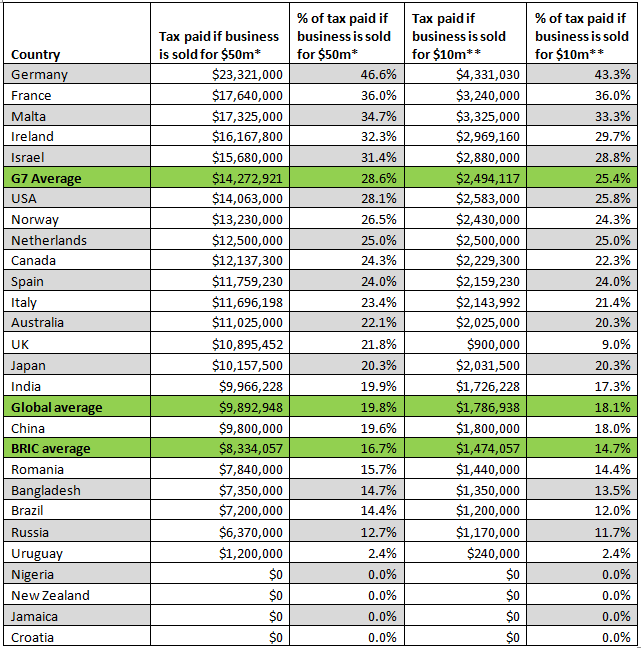
The tax take on business disposals in G7 economies risks seriously undermining entrepreneurship, with entrepreneurs in the G7 countries levying an average 28.6% in tax on the successful sale of a $50m business*, compared to a global average of 19.8%, according to a new study by UHY, the international accountancy network. 

UHY collected information on the tax regimes of 25 countries across its international network to compare how much profit an investor in a typical small or medium size business would be allowed to keep when they sell their stake in the business, based on an initial investment of US$1m and the sale of the stake for either US$10m or US$50m. 

In contrast to the G7, entrepreneurs selling a similar business in one of the BRIC economies would pay an average of just 16.7% in tax on their gain. 

UHY says that this disparity in the rewards for entrepreneurship between the BRIC and G7 economies puts the G7 at risk of discouraging entrepreneurialism and losing out as a destination for setting up a business.

UHY explains that low taxes on capital gains, especially those made by entrepreneurs, help compensate for the financial risk involved in expanding a business.  They create a stronger incentive to keep growing the business, creating new jobs, with a view to attracting a substantial buyer, rather than keeping it as a smaller lifestyle business that employs fewer people and is easier to manage.

The amount of tax paid by a successful entrepreneur in Germany and France is particularly high.  An entrepreneur selling a $50m company realising a $49m gain would pay 46.6% or $23.3m in tax in Germany and 36% or $17.6m in France.  Additionally, the partial relief for an entrepreneur in Germany selling a business of up to a profit of EUR5 million applies only to the over 55s, putting younger entrepreneurs at a key disadvantage.

The tax regime for entrepreneurs is more benign in the USA than in continental Europe.  An American entrepreneur’s tax bill from selling the same $50m business would be around 40% smaller than in Germany at $14.1m or 28% of the total sale price.

In the UK, the despite a headline tax rate of 28% on capital gains an entrepreneur selling a business of $10m** would pay just, 9% in tax, rising sharply to 21.8% after tax reliefs and exemptions, for a sale of $50m. While the headline rate is now substantially lower than the 40% rate CGT reached in the 1990s, UHY says that the wide discrepancy in the tax treatment of the sale of a more substantial business acts as a brake on entrepreneurs’ ambition to maximise the potential of their businesses.

UHY adds that in China – where the Ministry of Commerce estimates that entrepreneurial ventures are responsible for 75% of new jobs each year and 68% of exports – entrepreneurs are encouraged with a tax on capital gains below the global average.  Some smaller mid-size economies, including New Zealand, Jamaica, Nigeria and Croatia seek to encourage entrepreneurialism by exempting gains from the sale of a business in most common scenarios entirely.

Ladislav Hornan, Chairman of UHY, comments: “Historically G7 economies have been able to depend on a steady stream of business creation because their sheer size offers great opportunities.  However emerging economies are starting to rival them as a place to start a business; their business environments are becoming more benign, they offer growing pools of affluent consumers, increasingly skilled workforces – and as this study shows a much more favourable tax environment too.”

“G7 economies need to re-think how much they tax capital gains or risk losing ground to their rivals.  In particular, tax rules that favour older entrepreneurs seem antiquated at a time when technology companies create some of the world’s fastest growing businesses, and with them well-paid, highly skilled jobs.”

“Germany hopes to attract high tech start ups to low-cost Berlin, yet an aspiring German Mark Zuckerberg could face a much larger tax bill than an older entrepreneur in an industry offering far lower pay.”

UHY points out even in Ireland, generally considered to be a low tax economy, entrepreneurs would pay 32.3% on a sale of a $50m business, higher than Ireland’s maximum corporation tax rate of 25%.

Comments Alan Farrelly, of UHY Farrelly Dawe White Limited, UHY member firm in Ireland: “Irish entrepreneurs have been thin on the ground in the last few years, but with the economy improving, it could be time for the Government to consider encouraging domestic business creation by allowing entrepreneurs to keep more of their profits.”

The study assumed that the business did not qualify for any targeted investment reliefs (e.g. to encourage investment in clean technology), and that the entrepreneur is the sole owner and investor in the business, single, childless and a national of the country, with an annual income of US$200,000 and no immediate plans to reinvest his or her profits.

*with a profit of $49m based on an initial investment of US$1m.

**with a profit of $9m based on an initial investment of US$1m. 

table

*Assuming a profit of $49m.

**Assuming a profit of $9m

Mexico: the new middle way

Mexico is an economy in transition. It will take a generation or more for the transition to become complete. But, make no mistake, Mexico is on the move, empowered not just by large modern firms but small to medium-sized (SME) traditional businesses that are stepping up to take advantage of economic growth.

To date, transition among SMEs has been hard to find. But in pockets of enterprise, slowly but surely, they are benefiting from fiscal reform and professional support — and moving forward into a new Mexican era of increased effectiveness, productivity and international competition.

Research by the McKinsey Global Institute points to the long haul ahead. Productivity has grown by 5.8% a year in large, modern Mexican firms, but has fallen by 6.5% a year in traditional firms. In 1999, small traditional firms were 28% as productive as large modern ones, but by 2009 they were only 8% as productive.

For example, the 0.5 per cent of baking-industry employees who work in the very large, best-in-class corporates generate half of the industry’s added value. The vast majority of baking employees, however, work in traditional neighbourhood panaderías (bakeries) and tortillerías (small-scale tortilla factories), which achieve just one-fiftieth of the productivity of the best-in-class, large bakeries.

These ‘old versus new’ businesses reflect the dualistic nature of the Mexican economy as a whole. On one hand, ‘modern Mexico’ is a high-speed, sophisticated economy with cutting-edge auto and aerospace factories, multinationals that compete in global markets and universities that graduate more engineers than Germany.

In fact, Mexico has become one of the world’s top five auto producers. Annual production at the 10 largest Mexican plants rose from 1.1 million vehicles in 1994 to nearly 2.9 million in 2012. Many Mexican plants are regarded as world-class; some exceed average US productivity levels.

In food processing, Mexico’s Grupo Bimbo is a highly automated global player that has become the world’s largest baking company, with modern-format stores adopting the latest supply-chain management practices.

By comparison, ‘traditional Mexico’ is small-scale, low-speed, technologically backward and unproductive, often operating outside the formal economy (thereby avoiding taxes and other business costs).

What makes this gap frustrating, is that, so far, three decades of government economic reforms have failed to boost the country’s GDP growth.

Without capital to invest in new technology, the traditional sector has relied on manpower and a rising share of employment, creating jobs at a faster rate than the modern economy — the opposite of what typically happens as economies develop. Hence, GDP growth has stagnated. It fell to 1.1 per cent in 2013 (compared with annual average growth of 4.3 per cent between 2010 and 2012). Deceleration was driven by weaker export demand and a contraction in domestic investment, according to the World Bank.

Mexico’s GDP per capita has been similarly weak, rising by just 0.6 per cent per year on average (only 0.4 per cent during 2013) because of weak labour productivity, which fell from USD 18.30 per worker per hour (in purchasing power parity) in 1981 to USD 17.90 in 2012.

Key reforms for growth
Yet, the government – working towards mid-term elections in July 2015 – is pursuing with determination reforms in areas such as labour market regulation, education, telecommunications, financial sector regulations… The World Bank predicts a gradual recovery over the next few years, with more dynamic exports as the US economy gains pace, propelling economic growth back to the range of 3-4 per cent. Private investment, particularly in the liberalised energy sector, is expected to be key in enhancing economic growth.

Financial reforms, meanwhile, are aimed at promoting higher lending, particularly to SMEs at lower rates through development banks – to counteract Mexico’s low credit-to-GDP ratio, which lags far behind international standards. The reforms are designed to:

•  Increase the role of development banks

•  Encourage more lending by private sector banks

•  Increase competition among commercial banks

•  Strengthen the stability of the financial system.

Currently, in a Central Bank of Mexico survey, more than 80 per cent of Mexico’s capital-starved SMEs quote their credit sources as ‘suppliers’ (suggesting informal arrangements) rather than banks. Research shows that an important determinant of access to formal credit is to have had that access before – which automatically excludes firms with no credit history. The World Bank estimates that, as a result, more than half of Mexico’s SMEs have insufficient access to financial services.

Government reform of development bank support is aimed at increasing financial inclusion for smaller businesses. The government’s finance minister has given examples of how development banks could be utilised. One example is a guarantee by a development bank to underwrite commercial banks that give credit to firms with no credit history. According to the Ministry of Finance, in just one month the programme supported 6,000 firms.

Increasing credit to firms, particularly SMEs, will increase growth through more investment and through more consumption, creating a virtuous circle between credit and economic growth in Mexico, says Bank of America Merrill Lynch, welcoming the moves. However, for development bank credit to fuel growth, loans need to be directed to projects that create more jobs – projects created through SMEs that create about 70% of total employment.

Till now, however, government reforms have been enthusiastically adopted by modern businesses, many with global ambitions, but have barely touched ‘the other Mexico’, where traditional enterprises have operated in ‘the same old ways’, informality has risen, and productivity has been plunging, says McKinsey Global Institute. Overall, the productivity gains of modern companies have been all but offset by the decline in traditional businesses, leaving economy-wide productivity growth at about 0.8 per cent a year since 1990.

“For Mexico to get closer to its pre-1980 buoyant GDP growth rates, raise per capita income, grow the middle class, and bring more people out of poverty… the government must find a way of narrowing the gap between the ‘two Mexicos’ “, says McKinsey Global Institute.

Policies and practices that discourage traditional businesses from formalising in order to qualify for financing and invest in growth need to be rethought. More companies and workers need to move into the modern economy, creating a vibrant and globally competitive SME sector. More companies need professional support to grow and develop.
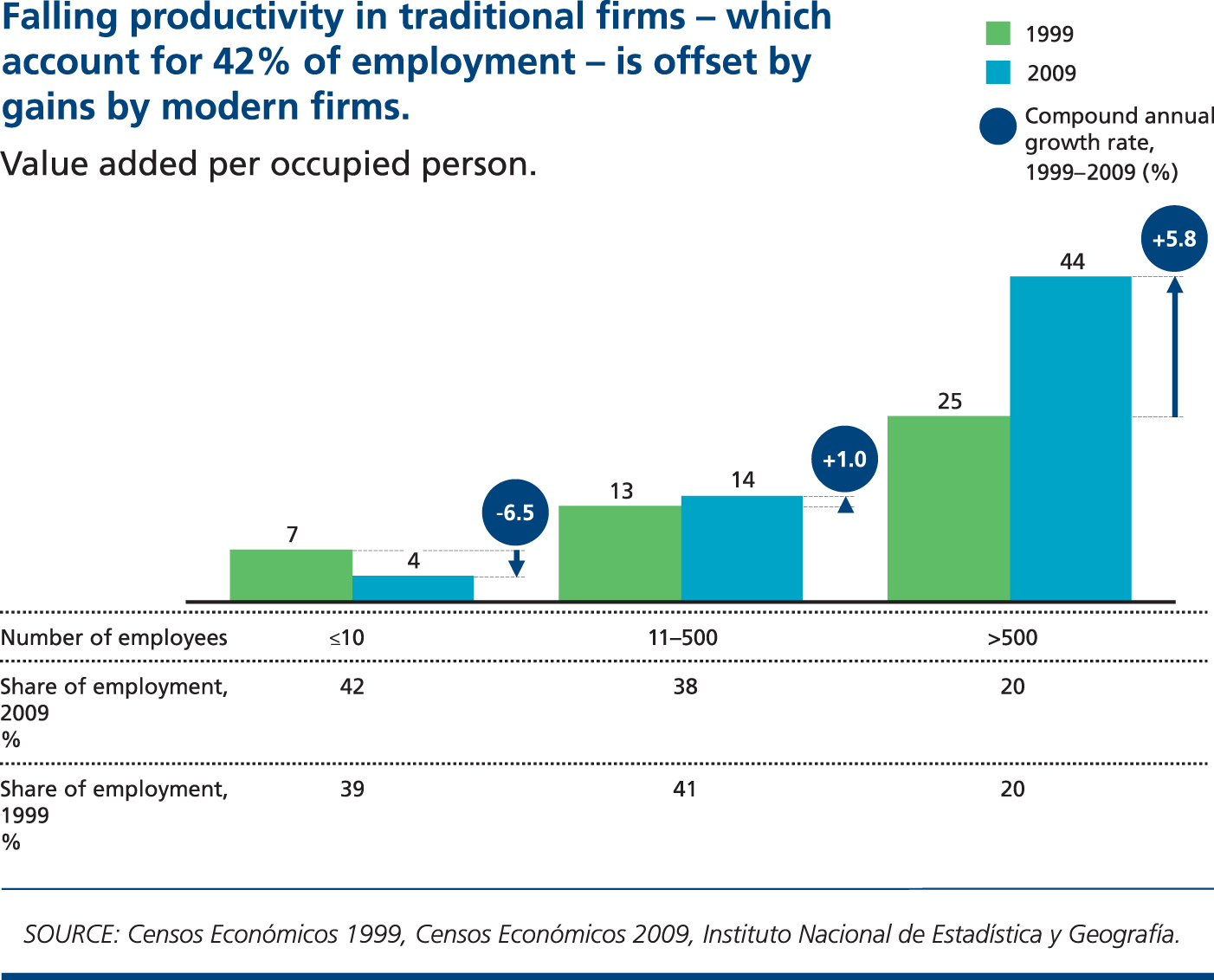
Mexico chart

UHY’s member firm in Mexico, UHY Glassman Esquivel y Cía S.C., is at the forefront of supporting SMEs as they modernise. “We’re looking to create a business environment that encourages entrepreneurship and growth and removes economic barriers and short-sighted incentives, which, in the past, have encouraged businesses to remain small and informal,” says managing partner Oscar Gutiérrez Esquivel.

Falling productivity in traditional firms – which account for 42% of employment – is offset by gains by modern firms.

Value added per occupied person.
(Many companies have remained small and continued to operate informally because of these economic incentives. The regulatory cost of establishing and operating a formal enterprise in Mexico is relatively high, and enforcement is weak and too often tainted by corruption, enticing companies of all sizes to conduct all or part of their business beyond the strictures of the formal economy.)

“More viable regulatory enforcement would also help companies join the formal economy,” says Oscar Gutiérrez Esquivel. Currently, it costs twice as much (as a percentage of average income) to register a business in Mexico as in Chile — and seven times as much as in the US.

(Not only is it far costlier to start a formal business in Mexico than in peer countries, but it also costs more to expand: construction permits cost three times the average income per capita compared with 67 per cent in Chile. There are also wide variations in regulatory processes and regulations within Mexico: it takes six days to start a business in Monterrey and 49 days in Cancún.)

Despite reforms, requirements in Mexican labour regulations also discourage the hiring of full-time employees. Companies have limited flexibility to lay off workers or hire part-time employees. They must also contribute to profit-sharing plans.
To skirt these requirements, more and more employers are hiring even core personnel through contractors.

Broad measures needed to support growth across the Mexican economy include reducing electricity costs, upgrading infrastructure, improving labour-force skills and continuing to improve security. These ‘enablers’ will be important for continuing productivity improvements of modern and traditional companies alike — steps that are critical to reaching overall productivity goals.

How the two-speed economy came about
For three decades from the early 1950s, Mexico urbanised and industrialised at a rapid rate. GDP rose by an average of 6.5 per cent annually. From 1950 to 1970 productivity rose by 4.3 per cent a year on average. The ‘Mexican Miracle’ was hailed as a model for economic development.

That era passed, however, and growth has never fully recovered. An expansion of public spending under the ‘shared development’ programme in the 1970s led to financial imbalances that proved unsustainable when oil prices plunged, resulting in a financial crisis and devaluation in 1982.

Since 1981, GDP growth has averaged 2.3 per cent a year — mostly due to the expanding labour force — and GDP per capita has grown by just 0.6 per cent a year. Labour productivity, which fell sharply from its 1981 peak, has yet to recover completely in purchasing power terms. In 1980, Mexican GDP per capita was 12 times China’s GDP per capita. At current growth rates, China could surpass Mexico by 2018.

Volatile energy prices and financial crises have been part of the explanation, but stagnation among traditional enterprises, that limits GDP and productivity growth, has been at the heart of this malaise. Traditional enterprises employ 42 per cent of all workers, yet in 2009 contributed just 10 per cent of the total added value to the Mexican economy.

Lack of capital compels traditional companies to rely excessively on labour-intensive methods to raise output (often using family or informal workers), rather than making capital investments — thereby exacerbating the productivity problem. Lending in advanced economies, as a share of GDP, is 4.5 times higher than in Mexico. At 33 per cent of GDP, Mexico‘s lending places it behind Ethiopia, a nation with much lower GDP per capita.

To raise GDP growth to 3.5 per cent, the Central Bank of Mexico’s growth projection for 2014, productivity would need to rise by 2.3 per cent annually — almost three times the rate between 1990 and 2012. To meet the government’s 6 per cent goal would require raising productivity by 4.8 per cent annually, or about six times the rate of the past two decades.

Opportunities for increased productivity
“We see abundant opportunities to raise Mexican productivity to rates that would accelerate GDP growth,” says Oscar Gutiérrez Esquivel.

“Mexico has many of the ingredients in place for both productivity improvement and accelerated GDP growth. It has not stinted on investment — roughly one-quarter of its GDP goes into fixed capital investment, a rate that is among the highest in Latin America. And Mexico’s macroeconomic environment has become increasingly stable over the past decades.

“Mexico has adopted many important market-opening reforms that have enabled the success of highly productive modern companies. As these large private corporations have been exposed to global competition at home and have expanded abroad, they have sharpened their operating skills. Such success is being translated into the SME sector, creating a new middle layer of entrepreneurial businesses focused on growth.”

With professional support, such enterprises are introducing labour-saving equipment and improving basic business processes. “Some strategies, such as investing in productivity-improving equipment and technologies, may be beyond the reach of some traditional enterprises that lack scale and access to capital,” says Oscar Gutiérrez Esquivel. “However, companies of all sizes can introduce improvements such as adjusting product mix to include more high-value-added items. In addition, small enterprises can join buying consortia to qualify for discounts and gain access to better raw materials. In this way, for example, small bakers might raise quality and generate higher profits to invest in productivity-improving equipment.”

Food and beverage stores, the largest sub-segment of the retail industry, present an enormous opportunity for productivity improvement. Today, modern-format chains account for 65 per cent of sales. Yet traditional mom-and-pop stores, market stalls and counter stores continue to proliferate. They employ 84 per cent of workers in food and beverage retailing but have only 20 per cent of the productivity of modern stores. Many small stores have limited display space, requiring workers to take orders or suggest items to customers and fetch merchandise from storerooms, lengthening transaction times and hampering productivity.

“More small companies need to grow into modern mid-sized companies, and more mid-sized companies need to grow into large modern corporations,” says Oscar Gutiérrez Esquivel. “By helping traditional enterprises evolve into modern, formal SMEs, with appropriate government actions to make informality less attractive, assistance from the private sector, and efforts by small business owners, many of Mexico’s traditional enterprises can evolve into the new breed of modern companies in the new middle-sector, ‘middle way’ economy.”

 

ASEAN: A region of complexities and contradictions

Investors and multinationals are increasingly turning their gaze southward to the dynamic markets that make up the Association of Southeast Asian Nations. ASEAN encompasses Brunei, Cambodia, Indonesia, Laos, Malaysia, Myanmar, the Philippines, Singapore, Thailand and Vietnam — economies at vastly different stages of development, but all sharing immense growth potential.

ASEAN is a major global hub of manufacturing and trade, as well as one of the fastest-growing consumer markets in the world. As the region expands its ties and captures an even greater share of global trade, its economic profile is rising — and investors are examining one of the world’s most diverse, fast-moving and competitive regions.

The 10 member states of ASEAN collectively comprise the seventh-largest economy in the world. Together, they form an economic powerhouse with a combined GDP of USD 2.5 trillion. By 2050, the region is projected by economic analysts IHS to rank as the world’s fourth-largest economy.

Labour-force expansion and productivity gains drive the ASEAN success. With more than 600 million people, ASEAN has the third-largest labour force in the world, behind China and India, and one of the world’s most youthful. Almost 60 per
cent of growth since 1990 has come
from productivity, as sectors such as manufacturing, retail, telecommunications and transport become more efficient.

Yet, in this land of complexities and contradictions, workforce skills are under-developed in parts of the region, most notably in Indonesia and Myanmar, where the McKinsey Global Institute predicts the workforce will be under-supplied by 9 million skilled and 13 million semi-skilled workers by 2030.

Indonesia represents almost 40 per cent of the region’s economic output and is a member of the G20, while Myanmar, emerging from decades of isolation, is a ‘frontier market’. GDP per capita in Singapore is more than 30 times higher than in Laos, and more than 50 times higher than in Cambodia and Myanmar.

Such diversities extend to culture, language, religion… Indonesia, for example, is almost 90 per cent Muslim, while the Philippines is more than 80 per cent Roman Catholic, and Thailand is more than 95 per cent Buddhist – making it imperative that investors are aware of local preferences for goods and services as well as cultural sensitivities.

Yet, much less GDP volatility than in other powerhouse regions (ASEAN has proved to be resilient in the aftermath of the 2008 global financial crisis and achieved an annual average GDP gain of 5 per cent since 2000); and increasing opportunities for integrated development opportunities throughout the region (see below) provide an attractive platform for growth and investment.

Vietnam stands out as a leading contributor to this growth – the country took just 11 years (from 1995 to 2006) to double its per capita GDP from USD 1,300 to USD 2,600.

Growth of the ‘consumer class’
ASEAN’s people are becoming ‘consumer class’ – extreme poverty is rapidly receding: in 2000, 14 per cent of the region’s population was below the international poverty line of USD 1.25 a day (based on purchasing-power-parity terms) but, by 2013, that proportion had fallen to just 3 per cent.

Already 67 million ASEAN households are among the ‘consumer class’, with incomes exceeding a level at which they can begin to make significant discretionary purchases (defined as households with more than USD 7,500 in annual income). That number is expected to almost double to 125 million households by 2025, making ASEAN a pivotal consumer market of the future.

There is no typical ASEAN consumer in this land of complexities and contradictions, but McKinsey Global Institute has identified broad trends: a greater focus on leisure, a growing preference for modern retail propositions, and increasing brand awareness.

Predictably alongside growth, ASEAN’s cities are booming. Today, 22 per cent of ASEAN’s population lives in cities of more than 200,000 inhabitants — accounting for more than 54 per cent of the region’s GDP. An additional 54 million people are expected to move to cities by 2025.

And ASEAN consumers are increasingly moving online: mobile take-up is 110 per cent (in effect, everyone has a mobile device and some have two) and internet usage stands at 25 per cent across the region. Its member states make up the world’s second-largest community of Facebook users, behind only the US.

But, again, there are vast differences. Singapore has the fourth-highest smartphone usage in the world and almost 75 per cent of its population is online. Indonesia, the world’s fourth-largest population, is rapidly becoming a digital nation; it already has 282 million mobile subscriptions and is expected to have 100 million internet users by 2016. By contrast, to date, only 1 per cent of Myanmar’s population has access to the internet.

Export trade developments
ASEAN is the fourth-largest exporting region in the world, trailing only the European Union, North America and China/Hong Kong. As its member states have developed more sophisticated manufacturing capabilities, their exports have diversified. Vietnam specialises in textiles and apparel; Singapore and Malaysia are leading exporters of electronics. Thailand has joined the ranks of leading vehicle and automotive-parts exporters.

Other ASEAN members have built export industries around natural resources. Indonesia is the world’s largest producer and exporter of palm oil, the largest exporter of coal, and the second-largest producer of cocoa and tin. While Myanmar is just beginning to open its economy, it has large reserves of oil, gas and precious minerals. In addition to exporting manufactured and agricultural products, the Philippines has established a thriving outsourcing industry, with China as its key customer.

Export-processing zones have been established across ASEAN. The Batam Free Trade Zone (Singapore–Indonesia), the Southern Regional Industrial Estate (Thailand), the Tanjung Emas Export Processing Zone (Indonesia), the Port Klang Free Zone (Malaysia), the Thilawa Special Economic Zone (Myanmar) and the Tan Thuan Export Processing Zone (Vietnam) are all expected to propel export growth.

One-market opportunities
Meanwhile, intra-regional trade could significantly grow through the ASEAN Economic Community. Some 25 per cent of the region’s exports go to other ASEAN partners and the total value is climbing rapidly as the region develops stronger cross-border supply chains.

The ASEAN Economic Community (AEC) integration plan is enabling freer movement of goods, services, skilled labour and capital as well as tariffs on goods now close to zero in many sectors among most of the member states. By this year (2015), AEC is aiming for regional economic integration by establishing:

• A single market and production base

• A highly competitive economic region

• A region of equitable economic development

• A region fully integrated into the global economy.

The AEC blueprint for cooperation (agreed at a 2007 summit in Singapore) includes human resources development and capacity-building; recognition of professional qualifications; closer consultation on macroeconomic and financial policies; trade financing measures; enhanced infrastructure and communications connectivity; development of electronic transactions through e-ASEAN; integrating industries across the region to promote regional sourcing; and enhancing private sector involvement for the building of the AEC. “In short,” says the AEC, “we will transform ASEAN into a region with free movement of goods, services, investment, skilled labour, and freer flow of capital.”

Beyond its borders, ASEAN has forged free-trade agreements with trading partners including Australia, China, India, Japan, New Zealand and South Korea. ASEAN has also been party to the Regional Comprehensive Economic Partnership trade negotiations that would form a mega trading bloc comprising more than three billion people, a combined GDP of about USD 21 trillion, and 30 per cent of world trade.

Consistent with this growth, foreign direct investment (FDI) in ASEAN has boomed and the region has become a launch pad for new companies; it accounts for 38 per cent of Asia’s market for initial public offerings. In 2006, ASEAN was home to the headquarters of 49 companies in the Forbes Global 2000. By 2013, that number had risen to 74. ASEAN includes 227 of the world’s companies with more than USD 1 billion in revenues.

India: pipedream or reality?

India gives a whole new meaning to diversity. The vast country has at least 15 major languages, hundreds of dialects, several major religions and thousands of tribes, castes and sub-castes.

A Tamil-speaking Brahmin from the south shares little with a Sikh from Punjab — each has his own language, religion, ethnicity, tradition and mode of life.

So it makes you wonder, how realistic is the contention from economic observers that, by 2022, growth will create one urban middle class whose interests transcend region, caste, religion…? What will India look like by 2022, and what opportunities and challenges will investors encounter?

“India will continue to remain an attractive investment destination, more so since there seems to be a lot more stability on the central government front,” says Sunil Hansraj, Chandabhoy & Jassoobhoy & Affiliates, one of UHY’s two member firms covering India. “With the new government having come to power in May last year, there was an expectation of ‘big ticket’ reforms and policy announcements which, though not seen as yet, are expected to be put in place steadily over the next six to eight months.

“The government is placing great emphasis on reviving manufacturing and increasing investment in infrastructure, which are expected to put the economy back on track and boost growth. Industry is cautiously optimistic on this front and many large corporate houses are already seeking to increase their investments.”

Cities: the place of wealth
Most of India’s wealth is already generated from its cities and towns. Urban India accounts for almost 70 per cent of the country’s GDP. But almost 70
per cent of its people still live in rural India. As a consequence, for politicians, the cities have primarily become a place of wealth, development and tax generation, while the countryside is predominantly their place of legitimacy and power. The countryside is where the vote is; the cities are where the money is.

But, by 2022, the Indian government aims to have economically empowered 580 million of the 680 million currently unable to meet basic needs, creating a greater sense of united nationalism than ever before.

Economic liberalisation, say observers, will have created one national economy; technology will have created one national culture. As India grows its global awareness, by 2022 its people will be celebrating what distinguishes them from other Asian countries (rather than from each other) — and that will bind them together as one united nation.

Where are the investment opportunities?
It’s tempting to think that future investment opportunities have the most potential in ‘Urban India’ and among the new urban middle class. They do, of course, but opportunities also abound in government and state contracts supporting the administration’s bid to ensure poverty is finally in retreat.

India launched its first wave of economic reforms in the early 1990s, resulting in a decline in the official poverty ratio from 45 per cent in 1994 to 37 per cent in 2005. Over the next seven years, a period in which India achieved the fastest rate of economic growth in its history and also implemented policies aimed at helping the poor, extreme poverty declined rapidly to 22 per cent of the population, or some 270 million people. Now the government has set still higher aspirations: more than half a billion people are to be supported as they build a more economically empowered lifestyle.

Policy-makers at all levels of government, both national and state, are focusing on an agenda that emphasises job creation, growth-oriented investment, farm sector productivity and more innovative delivery of social programmes. While the framework and funding would fall to central government, many of the specific initiatives that will make this agenda a reality will be implemented at state level.

Products and services providing access to clean cooking fuel and electricity for lighting needs are in demand. Efficient sanitary latrines in rural households, and underground sewerage with wastewater treatment in urban households, are needed to cope with wastage and leakage. Primary, secondary and tertiary healthcare services are being identified, as are services in primary and secondary education (particularly vocational training).

Effective governance and supply chain control is also a priority. The government estimates that, on average, Indians lack access to 46 per cent of the services they need and, significantly, just 50 per cent of government spending actually reaches the people it is intended to reach — much of it is lost to inefficiency or corruption. During 2005–2012, 35 per cent of India’s food subsidy, for example, did not reach consumers, and the poorest population segments received less than 40 per cent of the subsidy intended for them.

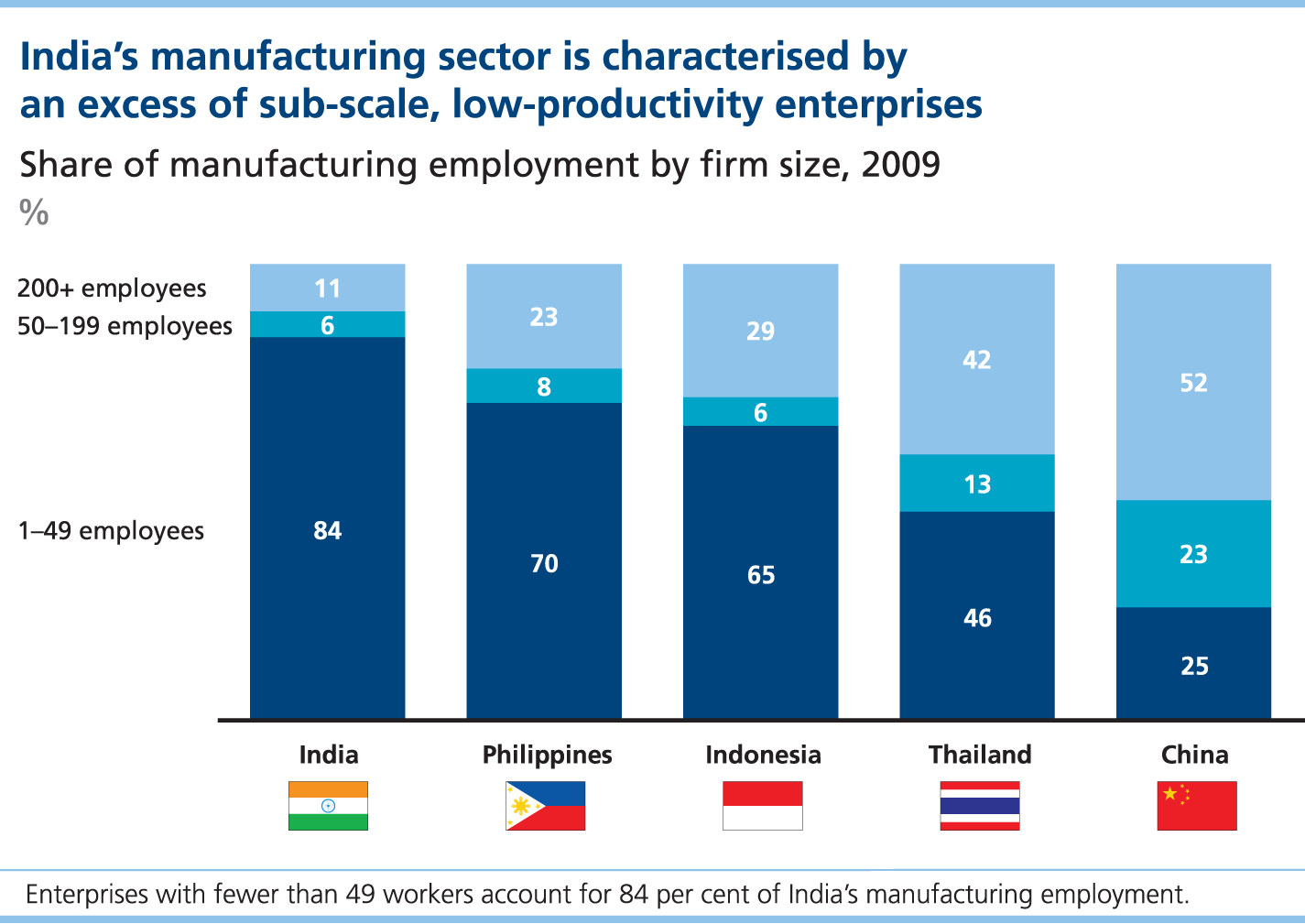
India’s manufacturing sector is characterised by an excess of sub-scale, low-productivity enterprises

Share of manufacturing employment by firm size, 2009
%

There are too few job opportunities outside the farm sector, a factor that limits the economic opportunities available to women in particular. In fact, just 57 per cent of India’s working-age population participates in the labour force — well below the norm of 65 to 70 per cent in other developing countries.

India’s labour productivity also lags because of the high prevalence of poorly organised and sub-scale businesses. Enterprises with fewer than 49 workers accounted for 84 per cent of India’s manufacturing employment in 2009, compared with 70 per cent in the Philippines, 46 per cent in Thailand and just 25 per cent in China. Micro enterprises in India, across both manufacturing and services, typically have just one-eighth the productivity of larger enterprises with more than 200 workers.

Indiachart

Focusing on productivity of the agricultural sector to lift the incomes of smallholder farmers is one of the most direct routes to addressing rural poverty. Yet, agriculture has not kept pace with growth in India’s broader economy. Today the nation’s yield per hectare is half the average of China, Indonesia, Malaysia and Thailand.

Moreover, in the past, government spending on agriculture has focused on input and output price support rather than investment in agricultural infrastructure, scientific research and extension services (which educate farmers on new technologies and best practices). In 2010–11, the government spent Rs. 86,000 crore (USD 18 billion) on input subsidies (primarily fertiliser), but less than half that amount, (Rs. 34,000 crore, or USD 7 billion), on building storage and irrigation systems, as well as scientific research and extension services.

Source: Asian Development Bank, Key indicators for Asia and the Pacific.

Dream versus reality
But… is all this for real? India has a bumpy track record of economic reform and achievement. Are government empowerment targets achievable, or are they just a pipedream? The answer, predictably, lies somewhere in between.

When you explore the outcomes of strong economic growth over the past 20 years, matched by economic reforms (albeit currently stalled), the reality is that India has already started to transform itself. The Indian middle class now numbers more than 250 million and more than 30 per cent of the 1.2 billion population already lives in urban areas. These numbers are growing fast (fuelled not in small part by Indian movies featuring young, aspiring people filled with idealism and ambition).

Unusual in combining the growth of an emerging market with the openness of a free-wheeling democracy, India has also thrived on an information explosion, boasting more than 170 television news channels in dozens of languages. Three-quarters of the population have mobile phones.

Globalisation has raised expectations for this new urban middle class. Whereas once it was assumed that to get rich you needed political connections, today you can simply dare to have good ideas and work hard.

The Aadhaar programme (aadhaar means ‘foundation’ in Hindi), spearheaded by India’s tech pioneer Nandan Nilekani, is giving every Indian a unique biometric identity, aimed at making it possible for them to get their rights and benefits without middlemen, corruption or state inefficiency blocking their path. The programme, say observers, will enable Indians to think of themselves, for the first time, not only as members of a religion, caste or tribe — but as individuals.

Yet… India’s economic engine has been spluttering since 2011 and there has been a growing sense of legislative and administrative paralysis. In a scenario of stalled reform, the contrary view raises its head — that poverty will likely maintain its grip on a large section of India’s population; that, in the absence of major reforms, India’s GDP will grow at just 5.5 per cent from 2012 to 2022; and that, sadly, the effectiveness of government social spending will remain unchanged.

What’s needed to make the difference
For the government to reach its transformation targets, McKinsey & Company researchers estimate that India needs 115 million new non-farm jobs over the next decade to accommodate a growing population. India’s industrial sector will need to lead the way on job creation, especially in construction and manufacturing. These sectors can absorb lower-skilled labour moving out of farm jobs. Labour-intensive services — such as tourism, hospitality, retail trade and transportation — will need to add 35 million to 40 million jobs.

Almost half of the required jobs will need to be generated in states with difficult starting conditions (such as challenges with the quality of education, which exacerbate skills shortages). Uttar Pradesh’s labour force, for example, say researchers, will need some 23 million non-farm jobs (approximately one-fifth of the national requirement) — even though the state is largely rural and organised enterprises currently account for only 9 per cent of its employment. Some 11 million workers from the state of Bihar will need to be absorbed into the non-farm sector in an even less advantageous climate. “India’s job-creation strategy must provide broad-based reforms that invigorate job growth, both in these regions and across the entire country,” say the researchers.

“As China moves up the value chain, India and other emerging economies with low labour costs have an opportunity to capture a larger share of labour-intensive industries by integrating domestic manufacturing with global supply chains. But an array of barriers limits the ability of Indian businesses — both large and small — to invest and become more competitive, scale up and create jobs.”

Revitalising India’s job-creation engine will require decisive priority reforms, say researchers:

India needs to accelerate critical infrastructure for power and logistics Infrastructure gaps, especially in power and transportation, hinder economic growth, particularly in manufacturing.

The administrative burden on businesses needs to be reduced Complex and archaic regulations pose a significant cost, especially for micro, small and medium-sized businesses, discouraging both investment and their move into the formal economy.

Government services should be selectively outsourced to private-sector providers
The roll-out of ‘one-stop shops’, supported by automated government processes, can be accelerated through outsourcing.

Tax distortions need to be reformed India’s many taxes result in high compliance costs, and differences across states and sectors balkanise the national market, harming the ability of businesses to achieve economies of scale. The proposed goods and services tax, a harmonised consumption tax across nearly all goods and services, represents a step towards reducing complexity and lowering the tax burden.

“The goods and services tax is still work in progress, though the government seems to be making reasonable progress in discussions with the states,” says Sunil Hansraj. “The next four to six months could give us a clear indication of how and when the tax regime would be implemented.”

Land markets need to be rationalised In 2013, India enacted the Land Acquisition, Rehabilitation and Resettlement Bill, which was intended to create a framework to deal fairly with the displaced. However, inefficient land markets remain a major impediment to economic growth, as property rights are sometimes unclear and the process for land acquisition is time-consuming. India can reinforce property rights by demarcating land holdings through geospatial surveys and provide standardised title to landowners through digitising records.

Labour markets need to be more flexible
At least 43 national laws — and many more state laws — create rigid operating conditions and discourage growth in labour-intensive industries. But, ironically, they secure rights for only a tiny minority of workers. A multitude of rules that restrict terms of work and work conditions should be simplified or eliminated. In the medium term, India could rationalise laws governing dismissal, pairing this with measures to reinforce income security for the unemployed.

Government-funded mechanisms need to help poor workers build skills Vocational education is needed most acutely by the poorest workers — those with little or no education and those who live in rural areas. There are 278 million Indians of working age in these categories, but they are underserved.

STAAR Surgical

STAAR Surgical is a leading eye implants manufacturer for refractive and cataract correction, with headquarters in Monrovia, California, the US and international offices in Nidau, Switzerland, and Tokyo, Japan. UHY Fay & Co, Spain, provides STAAR Surgical with tax and legal services, including incorporating a new branch of the multinational in Spain, obtaining the legal licence to practice in the country, tax compliance for the group’s activity, and preparing its transfer pricing manual to comply with Spanish legislation affecting related party transactions.

Read more.

Minco Plc

Minco Plc with offices in London, UK, and Toronto, Canada – is a base metals exploration and development company. UHY’s member firms, UHY Farrelly Dawe White Limited, Ireland, and McGovern, Hurley, Cunningham, LLP, Toronto, Canada, are engaged by Minco to provide annual audit services, as well as tax services.

Read more.

Zöllner Holding

Zöllner Holding, founded in 1946, is a world market leader in the manufacture of acoustic signal systems for shipping and automatic warning systems for railway applications.UHY Moreira – Auditores, Brazil, provided tax, accounting, legal and administrative services to Zöllner in Brazil. UHY Fay & Co, Spain, provided accounting, including group reporting, tax and labour advice services to Zöllner Signal Systems Ibérica, S.L. in Spain.

Read more.